I don’t know whether to blame boredom or the hormones in this particular portion of my cycle, but a few days ago I started watching The Horror of Dolores Roach.
I had been skipping around the thumbnail on Prime for a while, interested that it starred Justina Machado, but wary of anything with “horror” in the title.
You see, I hate seeing killing on screen. Things where people are screaming, running, trapped by predators who hack them to death? Not for me. But this time, maybe because I was pulled in by the promise of redemption for the killer, I got invested.
The Horror of Dolores Roach is about Dolores Roach (nee Rocha), a woman who spent sixteen years in prison after her no-good weed-dealing boyfriend Dominic set her up to take the fall for his crimes. She comes out into a wildly different world, stumbling into her now-gentrified neighbourhood looking for her ex, so that she can finally be back with the one person she has known as her “home” since she lost her parents at a very young age. Love is a strange thing: it can keep you holding on to a man who betrayed you in the worst way.
Of course, Dominic is nowhere to be found. Instead, Dolores finds herself seeking refuge with a man whose father owned the local empanada shop. He is also the man who, since he was a spotty teenager, had a massive crush on our Dolores. And here’s the first tangent that the show could have gone on: one man sent Dolores to prison, a new one will help her rebuild her life.

After speaking with Luis’s very optimistic young shop attendant (I have to guess, from the way she has a solution for almost every life problem and the high pitch of her voice, that she is Gen Z), Dolores decides to set up a vision board and make a plan for her new life. For a while, Dolores is using the massage skills she learned in prison (but wait, that’s dodgy in the ways that you may immediately think it is) to make herself enough money to move out of Luis’s basement and go back to school. She’s rebranding as “Magic Hands Dolores”. But the thing is that you can never quite shake off a dark past and a jonesing for revenge.
The action of every episode is driven by the murder of one or two people – any new character is guaranteed to be offed, and in that way the beats of the show are pretty predictable. Out of insanity or desperation or fear or anxiety or hopelessness, Dolores becomes a serial killer.
I suppose if they followed the redemption plot, then Dolores would be working steadily to earn her keep, reintegrate into the economy, find a good place to stay and go back to school. But that’s obviously not the story they wanted to tell here. No, they dial the drama and gore all the way up and lean very obviously and very heavily on Sweeney Todd: The Demon Barber of Fleet Street, but stylise the haircuts as massages and the pies as empanadas.
Luis is a great ally because he doesn’t question the dead body, he just immediately chops it up. When did the inspiration to cook people into his pastries hit? The second he saw the corpse? I’m just wondering if a cannibal is always a people eater, or it’s something that has to be activated. That said: does Luis actually eat any of it? I don’t think we see him chew on any of the Muy Loco empanadas… Maybe he just enjoys the idea of creating unknowing cannibals out of other people. (During one of their last heated confrontations, he says to Dolores: “I’m a pacifist! Look what you’ve turned me into!” – is this ironic? Or funny? Or just true?)
It’s intriguing, for sure, because cannibalism is one of those “can’t look away” topics. But given the way the show ends and how many times Dolores behaved as if she very much did not want to be a serial killer, I’m wondering why we had to go through this at all.
The environment of Dolores and Luis’s shops and of my lounge, or wherever I was watching the show, didn’t have much space for a conscience, guilty or otherwise. Things were moving at a clip and people were struggling to clean up (literally) their mistakes. I wanted to see what would happen next because I so hoped that there would be a happy ending. But killers, no matter what their motivations, don’t deserve happy, do they?
After Dolores breaks free of the shop she escapes into the margins of society. A theatre show about her life brings her out into the shadows, and she finds one last lead that could get her the revenge that started this whole mess. Someone says they know where Dominic is.
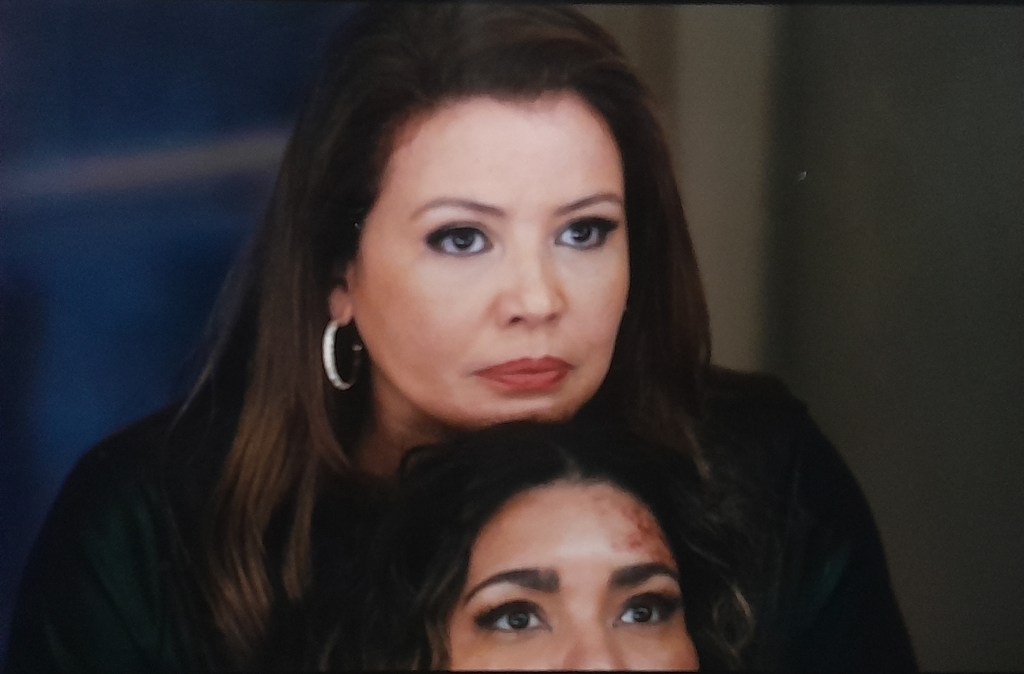
This leads us to a mysterious house where Dolores knocks on the door and, upon seeing the face of the owner when they open the door, breaks into a diabolical laugh before taking a deep breath,screaming and lunging at the person with her hands outstretched, ready to strangle them, most likely to death.
But who is this person? Is it Dominic at the house? It has to be, right? No one else makes sense… But what does seeing him now do? If he could leave her behind and fake his own death 20 years ago, he certainly won’t feel any guilt seeing her at this doorstep now. And she already killed all those people. It doesn’t matter who pushed her into that situation now – she made those choices.
That’s why, after 8 short episodes of chaos, desperation and interesting-enough writing, I must reiterate that I believe it’s okay for things to end. I don’t need limited series (based on podcasts, based on monologues) to keep ending on cliffhangers, especially when the question that the series builds up is easily answered.
Say it is Dominic, and Dolores turns out to be his final undoing and after years of being on the run she ends him. Okay, then what? And if that’s not what happens, then all the work they put into brewing this need for revenge that drives Dolores’s character will be for nothing. Things need to come to a head.
Anyway, watch this if you like stories where everyone is a villain but no one is a victim. It will give you something to think about.
 Nkhensani Manabe