Last week, as part of their special O-Week programme, the Wits Downstairs Theatre hosted a performance of Chapter Untitled: Your Love Is My Fantasy.

I had been looking forward to seeing it ever since I got the invitation, and saw that an old schoolmate of mine, Merriam Leeuw, had written and directed it.
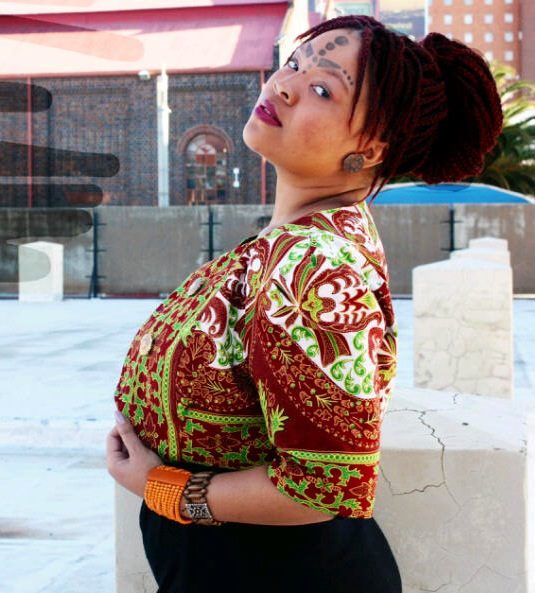 |
| Writer & director, Merriam Leeuw |
I had seen her acting before in Relativity: Township Stories, and I was impressed, so I knew that her first very own play would definitely be worth watching.
The play tells the story of Amaya, a driven young woman who is in the process of writing a very important book. She lives with her friend Bongeka, who is always trying to get Amaya to admit to her feelings for Chulu, and to take a step towards making their relationship happen. Bongeka wants Amaya to step out of her mind- her fantasies about love and how it should be- and live in the real world.
The dialogue is heavily influenced by the music in the play. As audiences step into the theatre, Louie Vega and Josh Milan’s Your Body is playing, and a line in the song- “…when we talk, you watch you stare…your love is my fantasy”- reveals where the title of the play came from.
Amaya begins her story with a monologue, which is done after music by Lesedi Dipheko sets the scene- the songs are called Your Love Is My Fantasy and Him. The lyrics tell the audience a little bit about what Amaya’s story is. In her monologue, she talks about opening her heart to love, and how she has found that taking this chance could lead to being deeply hurt.
The next scene introduces Bongeka, Amaya’s straight-talking, loyal, somewhat long-suffering friend, who brings humour and a light-hearted, frank attitude to the story. Bongeka advises Amaya to stop letting her past hold her back: she mentions an old relationship, and says to Amaya that what happened there should not stop her from pursuing Chulu.
Bongeka can be seen as the manifestation of Amaya’s unconscious thoughts: she is the one who brings reason to the turmoil of Amaya’s mind, and the fantasy she has created there.
Later in the scene, Amaya and Chulu are having what appears to be a BBM conversation.
Here, Leeuw decided to put a different spin on what the audience expects to see. The two characters- Amaya and Chulu- sit side-by-side on a couch, looking out into the audience with still, almost distant expressions on their faces, as if they have literally “zoned out”. Then they each pick up typewriters from the table in front of them, and proceed to type out their conversation.
Instead of a flashing screen, the messages “appear” on pieces of paper from the typewriter, and are passed back to Bongeka, who has walked into the conversation, and acts as the narrator for the audience.
Each paper that is passed back is equivalent to a flashing LCD screen, and the use of a narrator eliminated the need for a projector. This upped the entertainment factor of the scene, and kept the audience’s attention.
According to Leeuw, the conversation scene was initially going to involve a projection, but the idea of making the anonymous interaction over social networks into something tangible aided in the play’s quest to show how emotions are often fragmented and miscommunicated when technology interferes.
A day after the conversation, Chulu arrives unexpectedly at Amaya’s door. Amaya had only been preparing to see him the next day, and she is visibly thrown off by his presence: it means that she has to take action sooner than she had anticipated.
The two reminisce about when they last saw each other over dinner, and Chulu also says to Amaya that she needs to finish the book. At this stage, this statement has two meanings for Amaya and for the audience: she should finish writing the story, so that it can be published, and she should also resolve her issues with love- she should confess her true feelings to Chulu.
Further, the conversation hints at the fact that Chulu’s own fantasy might also involve him having the courage to begin a true relationship with Amaya.
It appears as if Chulu already knows what Amaya is too afraid to say, because he is confident and free in the way he speaks about having feelings for her, even dismissing the girlfriend which Amaya mentions as an obstacle to anything ever happening between the two of them.
The line “we both know how it ended up the last time we were together” let’s the audience in on the history of the characters’ relationship, and introduces a dance, choreographed beautifully by a lady named Bulelwa.
This second usage of alternative methods of illustrating a point within a performance (the first having been the use of typewriters) is something which Leeuw attributes to a close watching of the popular dance competition series So You Think You Can Dance.
The song Give Me Love by Ed Sheeran talks about the ways in which people desire to be loved- the needs which they want their partners to fulfill, and this speaks directly to the conflict which Amaya was having within herself about opening up to Chulu’s love.
The dance routine has the style of contemporary or lyrical dance, and the actors portray the turbulent emotions which occur at any point of a relationship with their bodies. This, I felt, was very clever and innovative of the director. It also extends the theme of music and performance being able to express what words and ordinary conversation do not have the capacity to. When we see the two dancing, it is as if we too are experience Amaya’s hesitation and Chulu’s encouragement to love. It was one of the major moments of the play.
Towards the end of the play, and after their reunion, Amaya and Chulu are having another conversation. This time, after Amaya has handed Chulu the finished version of the manuscript she had been working on.
The conversation proceeds along the lines of Chulu commending Amaya for finally opening up, and the audience is lead to believe that he and Amaya have finally resolved their fantasies and committed to a relationship in real life.
Ultimately, the story is about the heart, the mind, and the role each one plays in relationships. What are the consequences- for you, as well as those closest to you- of acting on or denying your deepest desires?
*The play is not running at the Wits Theatre anymore, but it will be showing at the National School of the Arts Festival of Fame showcase, after which it will be developed for a run at the Grahamstown National Arts Festival, which will be held from the 27th of June to the 7th of July this year.
Follow: @Nkhensani_M
@MISS_HONEY_TREE
 Nkhensani Manabe